This article recounts my trip to the Creation Museum and Ark Encounter on August 22, 2025. All photos were taken by me on this date.
Hello to my faithful readers and apologies for my leave of absence. A lot has happened since my last blog post! Namely, I moved to France and started graduate school. Obviously that didn’t take up all my time between now and last April. I also worked and then briefly traveled around the southeastern United States. This road trip functioned as a sort of “goodbye-for-now” to the U.S. and gave me the chance to explore uncharted territory. One of my stops was the Creation Museum in Petersburg, Kentucky.
To be candid, the Creation Museum wasn’t initially on my list. I only remembered its existence three days in, after driving absentmindedly around West Virginia and Kentucky (such is the beauty of road trips!). The concept of creationism has always enthralled me. I remember sitting in my bedroom at age fifteen watching Bill Nye debate Ken Ham on YouTube. It seems funny now to think that this issue struck such a chord with teenaged me. I suppose that the convergence of my early Catholic education, then-recent venture into the world of evolutionary biology, and undying love for the Rite of Spring sequence in Fantasia made me the perfect recipient for Bill Nye’s message. I felt like I had a personal stake in the outcome of the debate—and the culture war against creationism more broadly.
But I’m getting ahead of myself. Many of you may be wondering: What is the Creation Museum? Who is Ken Ham? Why are you forcing me to read this blog post? Fear not! All will be revealed!
Creation Science
For the uninitiated, the Creation Museum is a museum dedicated to the promotion of creation science. What is creation science? I’ve spent the last week trying to come up with a good answer to this question. Let me instead shirk that responsibility onto the Creation Museum itself. Here is an excerpt from their page titled “Creation and Science:”
Creationists love science! In fact, the word science means “knowledge.” We invite you to dive into the Bible and the scientific evidence with us to gather as much knowledge about God’s creation as you can. You’ll learn about the different types of science and discover facts and logical arguments you might have never considered. When you start with the Bible as your ultimate authority, you’re ready to discover creation science.1
The key sentence is the last one. Put simply, creation science is not science. It is the arbitrary selection and rejection of scientific facts and frameworks in accordance with a literal, historical-grammatical interpretation of the Bible. Creation scientists uphold science so long as science conforms to biblical history. It insists on no natural laws and is neither predictive, testable, nor falsifiable. Whereas science (in theory) is tentative, and scientists must be prepared to reject their theories, the faith of creation science adherents is unswayable. Science historian Michael Ruse sums up the matter well in his article “Creation-Science Is Not Science:” “This is not to say that religion is false, but it does say that religion is not science.”2
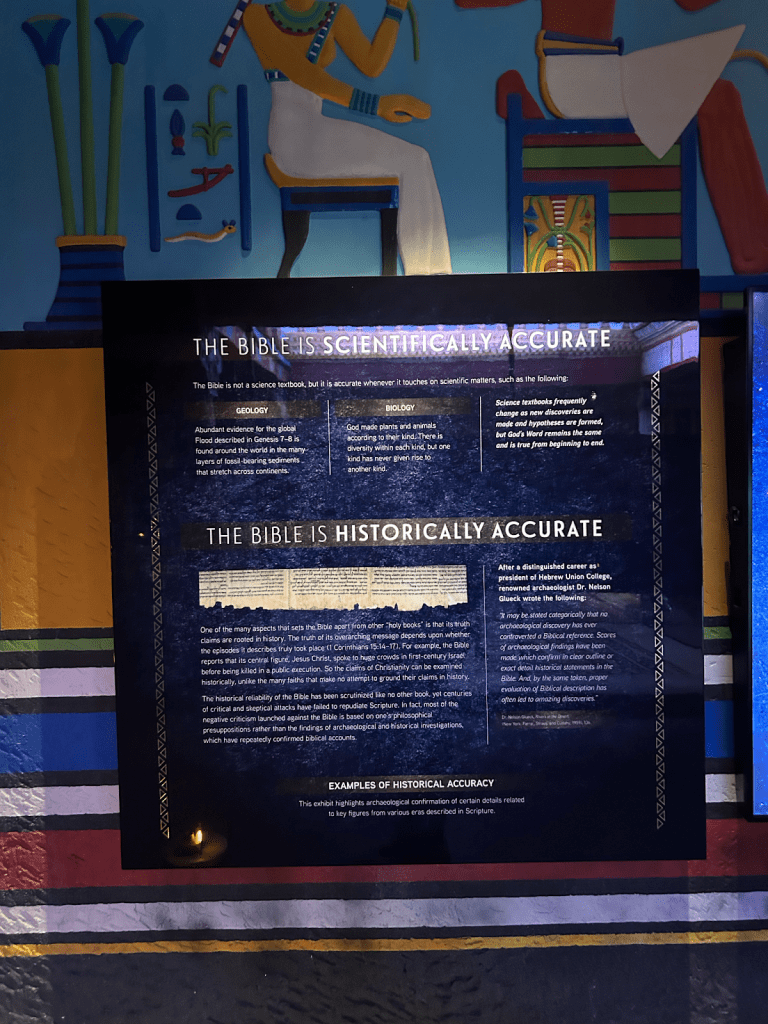
Not all creationists are bible literalists. There are even variants of creationism that are compatible with the doctrine of evolution. But creation science, by and large, is a fundamentalist enterprise. It is a form of Young Earth creationism, whose believers maintain that the earth is around 6,000 years old and was created by God in six days. Within this faction, Ken Ham (of Bill Nye debate fame) is something like a spokesperson. Ham founded the Christian apologetics ministry Answers in Genesis in 1994 to support and promote Young Earth creationism in the United States.3 (BTW—I thought “apologetics” was a pejorative descriptor applied to creationists by their detractors, but it’s actually how they self-identify.) In 2007, Answers in Genesis opened its $27-million-dollar masterwork: the Creation Museum.4
Gallup polls on evolution and creationism indicate that the ideological landscape of the United States has shifted since then. In 2007, 43% of Americans believed that God created human beings in their present form at some point in the last 10,000 years.5 As of 2024, that number has dropped to 37%.6 Meanwhile, the percentage of Americans who believe in strict evolution (i.e., that humans developed without any divine intervention) has risen from 14% to 24%.7 Even so, the Creation Museum continues to attract visitors. In 2022, Answers in Genesis reported that the museum and its sister attraction, the Ark Encounter, had welcomed their 10 millionth visitor.8

The Museum
Answers in Genesis’s Creation Museum is not the only museum in the world promoting creation science, but it is the largest.9 I haven’t visited the others, but I imagine it is the most impressive, too. The sheer scale of the compound amazed me, and each square foot is replete with enough imagery and text for a standalone article. Between the expansive parking lot and the museum itself lies an outdoor garden reminiscent of a theme park. Cinematic music carries in from unseen speakers—something between the scores of FernGully and Jurassic Park. It primes you for the fantastic experience in store: time will be traversed, paradigms will be toppled, and faith will be restored.
Upon entry, you might mistake it for a natural history museum; the Main Hall greets us with a replica mastodon skeleton (Phew! They believe in Ice Age megafauna!). Moving past this pachyderm, however, we come across the first of many striking dioramas. Leaves abound as two small animatronic dinosaurs perch by the edge of a babbling brook; feet away, two small animatronic children do the same. A New York Times article from the museum’s opening year remarks that this vignette “serves as a vivid introduction to the sheer weirdness and daring of this museum.”10 I knew beforehand that the Creation Museum had distilled various elements of Young Earth creationism into their distinct brand of creation science, but encountering an earnest depiction of human-dinosaur cohabitation was jarring. I took pictures and kept moving.
I am embarrassed but determined to admit that I paid $109.99 for entry. Included in the ticket price was admission to both the Creation Museum and the aforementioned Ark Encounter. I hope this isn’t spoiling the end of my review, but I don’t recommend patronizing either site. I know, I know! Do as I say, not as I do, etc. I just wanted to be up front about the absurdly high cost. I justified my purchase at the time by saying that it was for “research.” I can tell you now that it was mostly out of curiosity (related, but not quite the same). One can learn about the subject of creation science in different and better ways. And this YouTube video by Fundie Fridays provides a great rundown of the Creation Museum and Ark Encounter. Selfishly, though, I just really wanted to see it in person.
Curating Doubt
The Creation Museum’s first exhibit compares the beliefs of “creationists” to those of “evolutionists.” Basically, the walls argue, the “biblical creationist worldview” is just as legitimate as the “naturalistic evolutionist worldview;” they use the same evidence but happen to have reached different conclusions. The museum communicates this message with all the usual trappings of a natural history museum: authoritative signage with scientific-sounding language and detailed visuals. To the untrained observer, it can be easy to forget that this is an evangelical project with little concern for defending the scientific consensus.
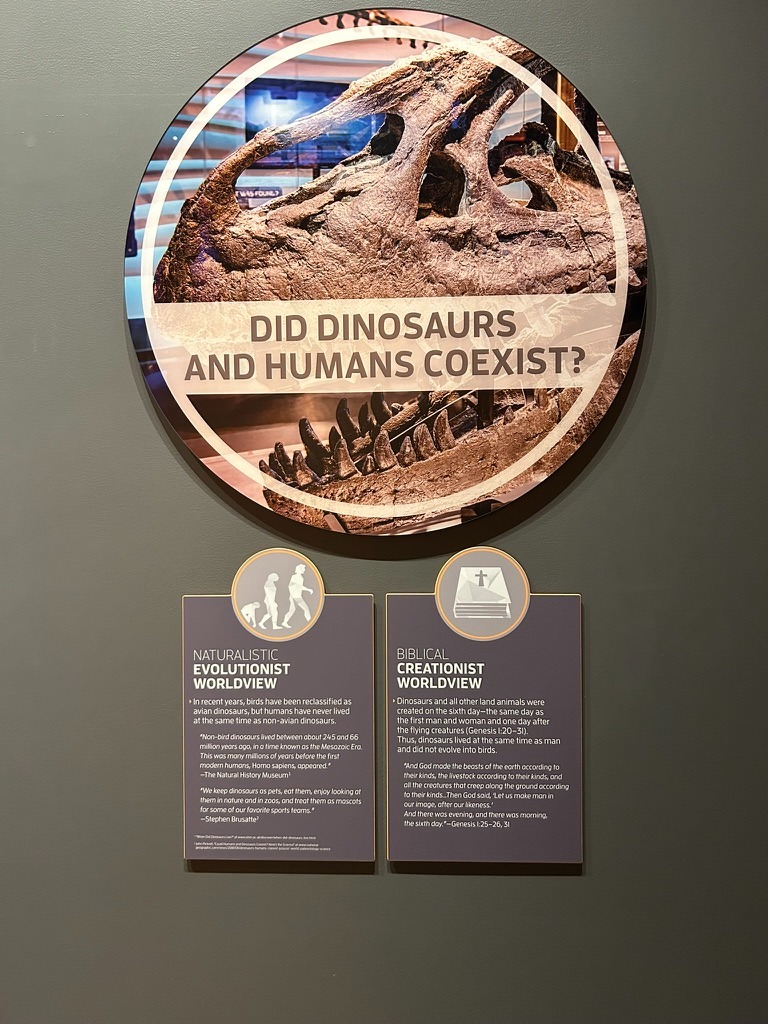
Authors Casey Kelly and Kristen Hoerl point this out in their article “Genesis in Hyperreality: Legitimizing Disingenuous Controversy at the Creation Museum.” They argue that the Creation Museum disguises its disregard for science by appropriating the stylistic signifiers of museums of natural history.11 I wholeheartedly agree; the sophisticated exhibit design and eye-catching dioramas reminded me of some of the better museums I’ve encountered. But if you scrutinize their substance, you soon realize that there’s hardly any information at all. Rather than providing compelling evidence for a young earth, the museum’s verbal and visual discourses persuade us of creationism by “cultivating uncertainty and skepticism in science.”12 Signs ask questions whose answers have long been known (e.g., Did dinosaurs and humans coexist? Are humans and apes related? Is climate change natural?). By disingenuously framing the debate surrounding evolution and related matters as ongoing, the Creation Museum does not communicate knowledge; it undermines it.
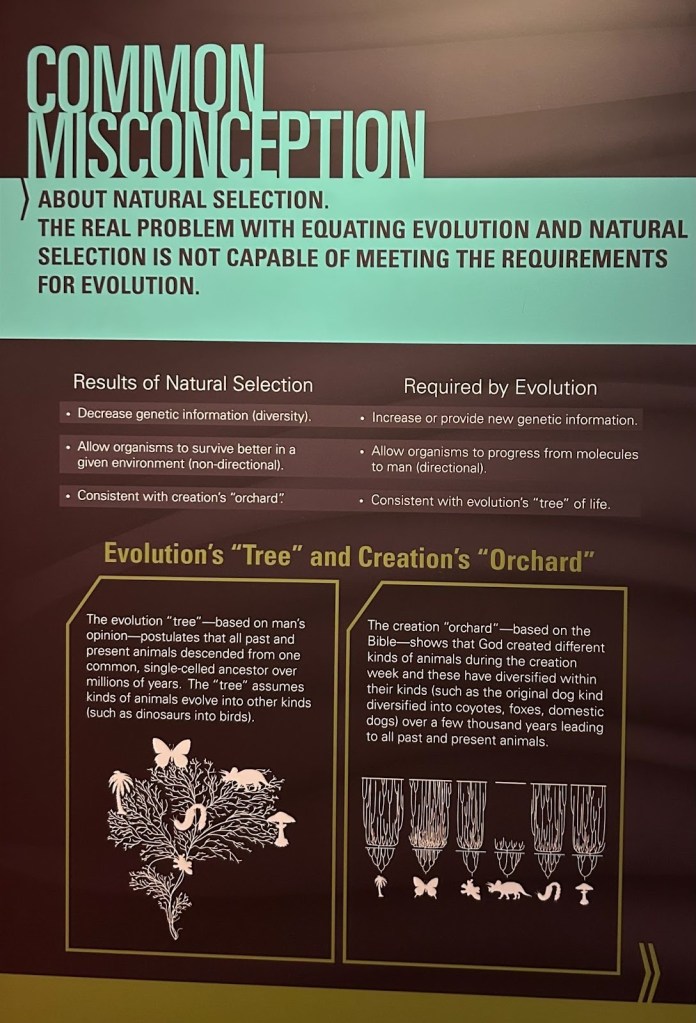
The museum’s explanations were, nevertheless, entertaining to read. Questions that come to mind (and questions that don’t) are swiftly and faithfully answered. What about radiometric dating? It has been known to “miserably fail,” one panel tells us. Doesn’t fossil evidence like Lucy suggest that hominids have evolved over time? No, Lucy was an ape who belonged to an “ape kind.” What about the fossils of other extinct creatures? They were animals that perished during the Great Flood around 4,400 years ago and in no way discredit creationism. But how on earth did Noah fit two of each extant species on the Ark? He didn’t; he took two of each “kind” of animal, which (upon leaving the Ark) reproduced and “generated” all the species we know today. Isn’t that evolution? No, it’s natural selection, which is different.
Laying Blame
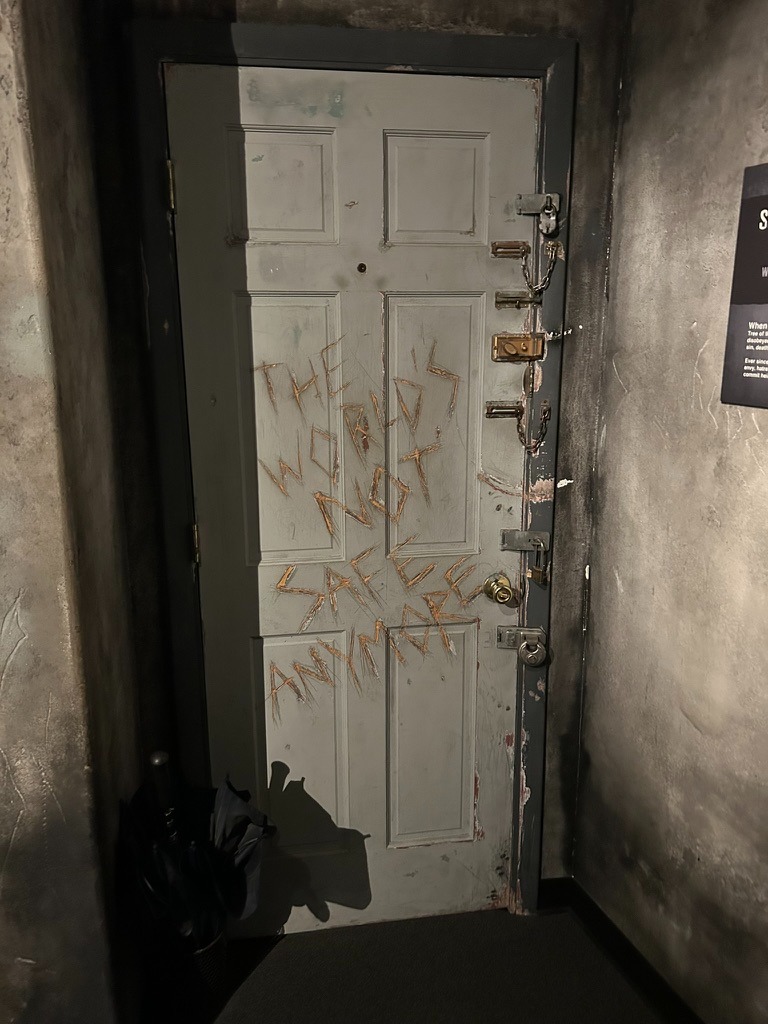
My least favorite part of the museum was the Cave of Sorrows. It comes just after the second of the “7 Cs in God’s Eternal Plan,” Corruption. If anyone cares, the complete sequence is as follows: Creation → Corruption → Catastrophe → Confusion → Christ → Cross → Consummation. Anyway, after we learn that Adam disobeyed God and thence begot all human suffering, the tone shifts dramatically. We enter what appears to be a doomsday bunker, complete with imitation concrete walls, dingy lighting, and a beat-up door with seven locks reading “THE WORLD’S NOT SAFE ANYMORE.” An arresting image of two emaciated men in a concentration camp confronts the viewer. This is the first time the museum directly references contemporary history. The image is flanked by a photograph of a child hugging a tombstone and another of a row of human skulls. The text above reads, “…through one man [Adam] sin entered the world […]”
The room shows us several more examples of suffering in the world—present-day and historical. They range from a woman grimacing during childbirth to a nuclear explosion, from a wolf raising its hackles (?) to 9/11. At the end of the presentation, a placard informs us that “This is NOT how it was MEANT TO BE!” Because man [Adam] sinned, we all have to suffer. It leaves you kind of annoyed at Adam, TBH. The wall tells us, “All of creation suffers from the effects of God’s judgment, because of sin, anxiously awaiting the day when God’s curse will be removed.” Other elements of the curse include disease, meat-eating, conflict, and weeds.
The Cave of Sorrows marks the beginning of a pattern; throughout the Creation Museum, historical atrocities are mobilized to bolster its apologetics. In the “Hall of Shame” exhibit, for instance, we are shown “painful reminders of a history marked by abuse and racism.” Examples include a copy of Mein Kampf, a photograph of a human zoo, and slave shackles—the destructive consequences of “human reason.” The museum posits that the Enlightenment (big mistake!) represented a wholesale rejection of the Bible as a source of truth and authority. The thinkers of this age embraced human reason, which tragically resulted in the development of the theory of evolution. Evolutionary theory, we are told, fueled racism; its most infamous application, per the museum, was the Holocaust. Ipso facto, human reason leads to genocide. (Additionally, a false equivalency is drawn between genocide and abortion, and there’s a creepy pink and purple pro-life room, but I can only cover so much in this recap.)
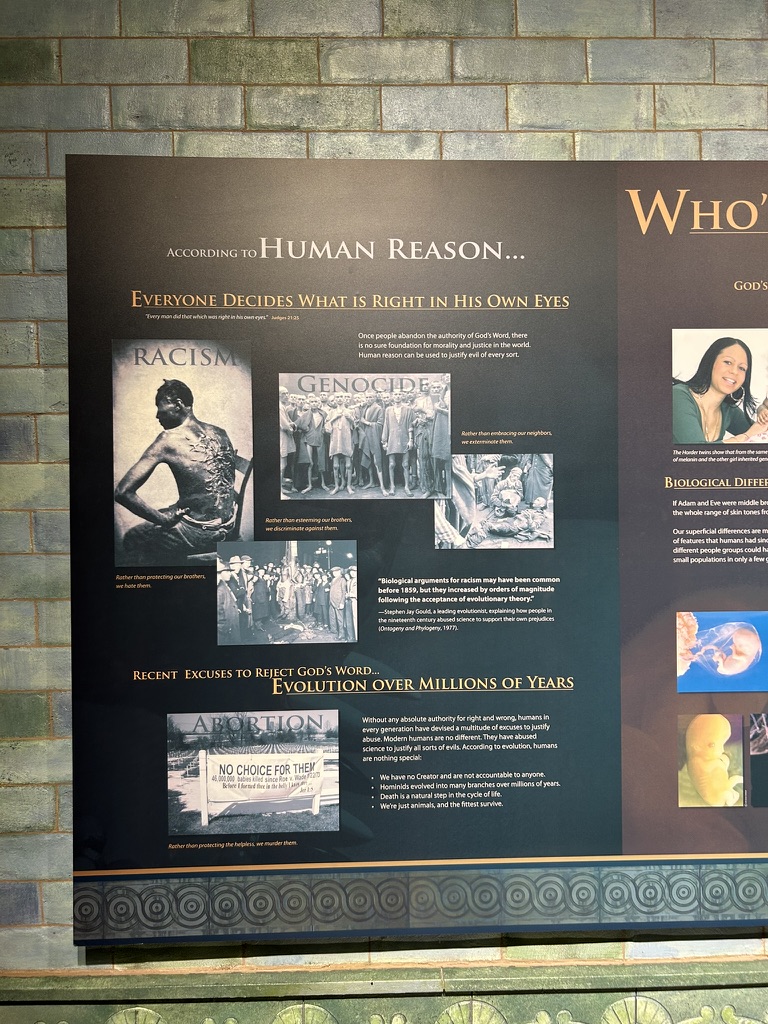
I won’t argue with all of the points that the museum makes about evolutionary theory. Indeed, many nineteenth- and twentieth-century thinkers saw the theory of evolution as confirmation of white supremacy. The field of anthropology was so rife with scientific racism that Franz Boas chose to dedicate an entire book to its debunking (I’m supposed to be reading it for one of my classes). It goes without saying, however, that the museum’s tone-deaf invocation of historical and contemporary racism only appears where it can be used to discredit evolution and support a literal reading of the Bible. Exhibits instrumentalize narratives of human suffering before turning our attention to ecclesiastical concerns. Like I mentioned before, the Creation Museum doesn’t provide proof for creationism so much as it cultivates doubt about the veracity of evolution and science more broadly.
The Ark
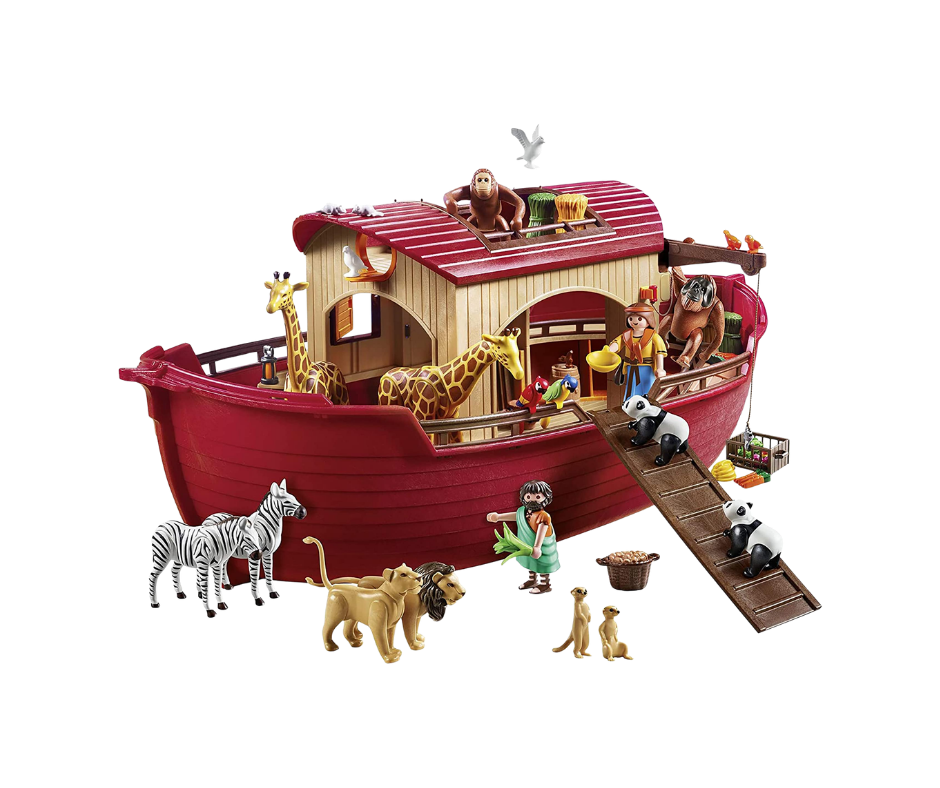
My visit to the Creation Museum would not have been complete without a trip to Answers in Genesis’s life-size Noah’s Ark (opened in 2016). As a big fan of the Playmobil set, I was excited to see Ken Ham’s interpretation. The Ark is a 45-minute drive from the museum, which was inconvenient but gave me time to think. The museum, to me, seemed to function chiefly as a form of reassurance for those who want/need it: You can keep believing in biblical creationism! There’s an entire museum to back you up! For the visitors who don’t subscribe to Young Earth creationism, it offers a funhouse mirror-version of a natural history museum. My museological expectations were reflected back at me in a grotesque way. I reflected for a while on the contrived nature of all human knowledge—before reminding myself that I’m really not obliged to find middle ground with Answers in Genesis.
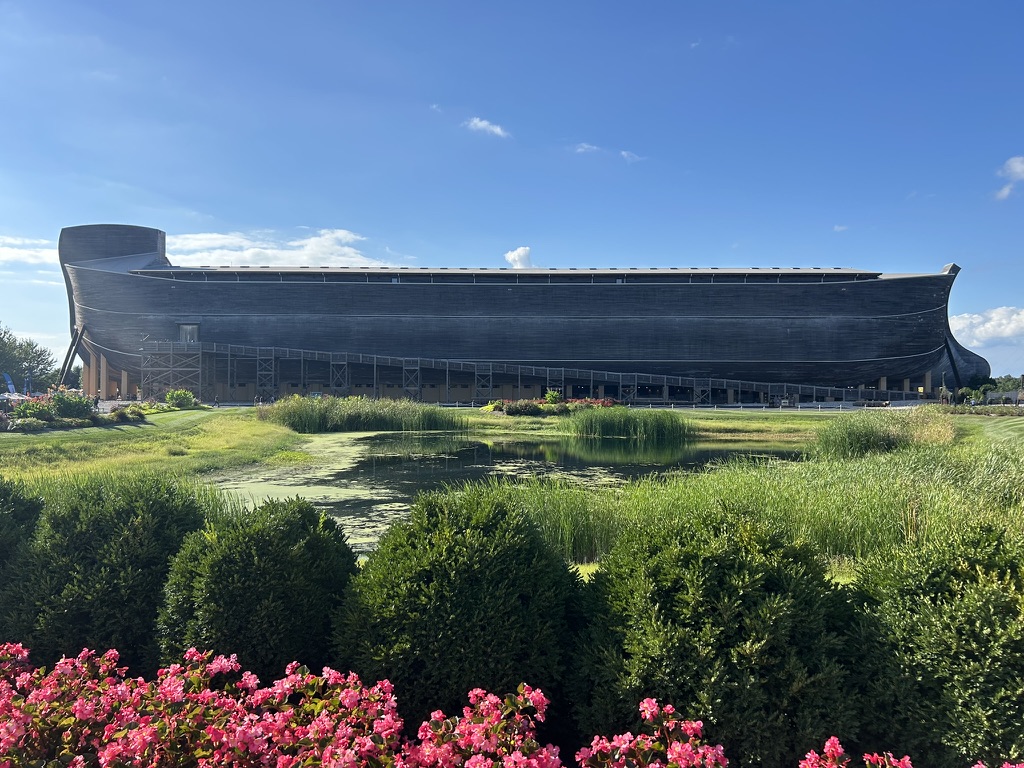
Boarding the 510-foot Ark Encounter, I found myself (as I am wont to do) thinking about Umberto Eco. In Travels in Hyperreality, Eco describes the United States as “a country obsessed with realism, where, if a reconstruction is to be credible, it must be absolutely iconic, a perfect likeness, a ‘real’ copy of the reality being represented.”13 Such was the nature of the Ark!!! Full-scale, and with every animal (or “kind,” rather) accounted for; solutions to the most far-out problems (could moths have been a renewable food source for reptiles?) proffered. It had three floors, and the interior was so nice that I wouldn’t have minded staying overnight (à la AMNH’s whale sleepover). I had an easier time enjoying myself at this attraction than I did at the other. I think the Creation Museum’s self-seriousness frustrated me, whereas the Ark reminded me of Mickey’s House at Disney World. It was still rife with evangelizing, but you could choose to ignore it and just look at the caged plastic animals.

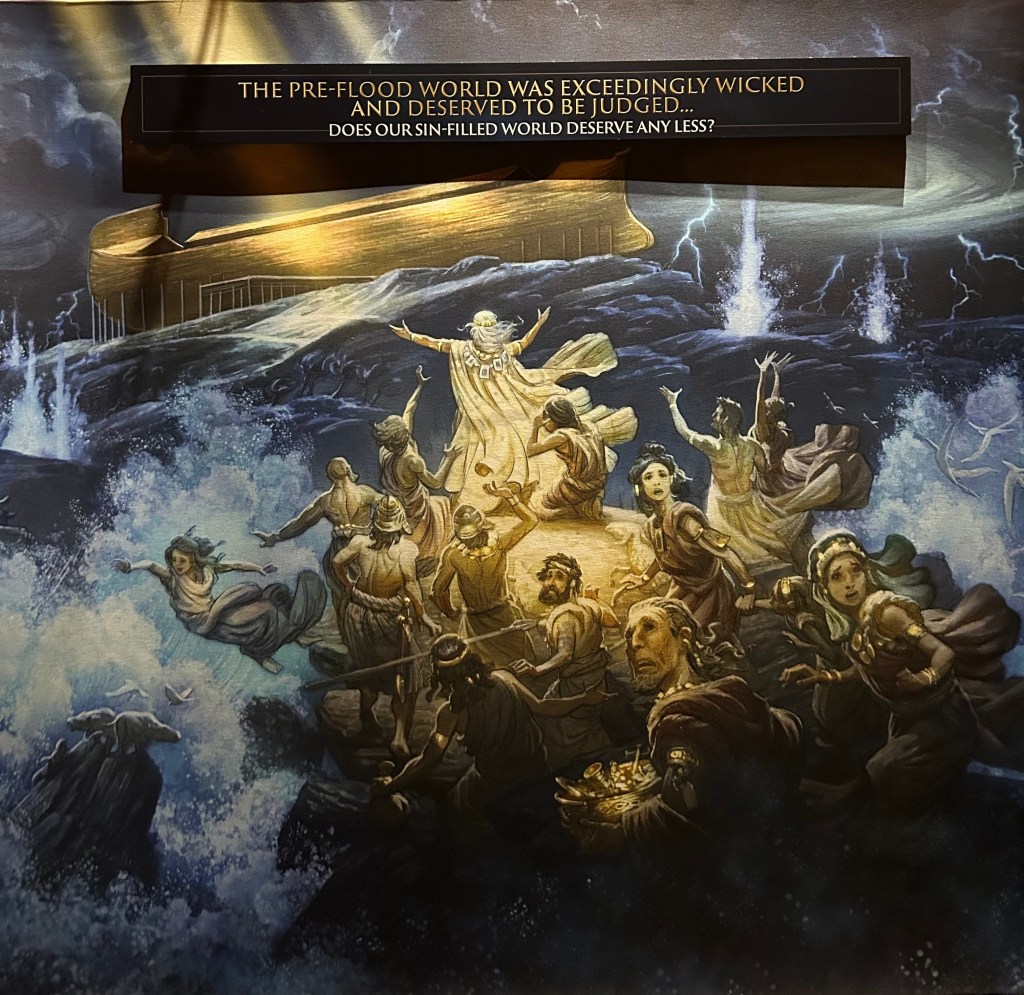
Still, a weird tension exists on the Ark. Though the environment is so incredibly fun and surreal—if I had visited as a kid, I’m sure I would have been running up and down the ramps and poking my head into every fake animal enclosure I could find—we are meant to be taking it seriously. Answers in Genesis wants us to believe that Noah was literally 600 years old when the flood came and that all life on earth today is descended from the animals he saved on his Ark. I’m not sure how many visitors actually bought it, and I was terrified to ask. A running theme throughout my day was the fear of being discovered; I anxiously hoped that my incredulity was not obvious to those around me. A bizarre, paternalistic impulse would come over me when I passed by little old ladies gleefully examining the exhibits. I felt bad for them; how could they be so easily deceived? For the kids I felt worse. I think that were it not for the other people at the Creation Museum and the Ark Encounter, I would have enjoyed myself completely. But they kept reminding me it was real.
Final Thoughts
I think that we all enter museums looking for evidence to support what we already believe. Case in point: I entered the Creation Museum expecting ridiculousness, and that’s what I found. I spent some time wondering what it would take for me to enter a museum with no preconceived notions, but honestly, I don’t think it’s feasible or even necessary. In preparation for this blog post, I read a ton of articles on Young Earth creationism. One of them addressed the impossibility of the biblical story Noah’s Ark, going through its claims point by point. After finishing it, I was kind of like, did this really need to be written? Like, should energy have been dispensed explaining why that which is impossible is impossible?
Funnily enough, the author seemed to agree; after thoroughly making his case, he brings up Hitchens’s razor—which proposes that that which is asserted without evidence can be dismissed without evidence—as if he means to suggest that taking these claims seriously is a fool’s errand.14 With this in mind, I will say that while the Creation Museum can be interesting and (in certain ways) instructive, its assertions don’t deserve our sincere consideration. And that, frankly, we give creation scientists too much credit by even pretending they are part of the discussion. I doubt anyone reading this article is seriously considering visiting the museum, but if you are, I suggest you take my mom’s unheeded advice and “not give those sons of bitches your money or your time.”
(If you do go, though, let me know because we have SO much to discuss)
- “Creation and Science,” Creation Museum, accessed January 21, 2026, https://creationmuseum.org/creation-science/. ↩︎
- Michael Ruse, “Creation-Science Is Not Science,” Science, Technology, and Human Values 7, no. 40 (1982): 72–78. ↩︎
- “History of Answers in Genesis,” Answers in Genesis, accessed January 26, 2026, https://answersingenesis.org/about/history/. ↩︎
- Edward Rothstein, “Adam and Eve in the Land of the Dinosaurs,” The New York Times, May 24, 2007, https://www.nytimes.com/2007/05/24/arts/24crea.html. ↩︎
- Megan Brenan, “Majority Still Credits God for Humankind, but Not Creationism,” Gallup.Com, July 22, 2024, https://news.gallup.com/poll/647594/majority-credits-god-humankind-not-creationism.aspx. ↩︎
- Ibid. ↩︎
- Ibid. ↩︎
- “Ark Encounter & Creation Museum Pass 10 Million Mark,” The Group Travel Leader | Group Tour and Travel Destinations, Attractions & More, May 3, 2022, https://grouptravelleader.com/articles/ark-encounter-creation-museum-pass-10-million-mark/. ↩︎
- “Creation Museum Draws Scientific Fire,” APS.Org, American Physical Society, July 2007, https://www.aps.org/archives/publications/apsnews/200707/creationmuseum.cfm. ↩︎
- Edward Rothstein, “Adam and Eve in the Land of the Dinosaurs,” The New York Times, May 24, 2007, https://www.nytimes.com/2007/05/24/arts/24crea.html. ↩︎
- Casey Ryan Kelly and Kristen E. Hoerl, “Genesis in Hyperreality: Legitimizing Disingenuous Controversy at the Creation Museum,” Papers in Communication Studies, 2012, http://digitalcommons.unl.edu/commstudiespapers/189. ↩︎
- Ibid. ↩︎
- Umberto Eco, Travels in Hyperreality, trans. William Weaver (Harcourt, 1986). ↩︎
- Robert M. Zink, “Noah’s Ark: A Saga of Science Denial,” Evolution: Education and Outreach 18, no. 5 (2025), https://link.springer.com/content/pdf/10.1186/s12052-025-00220-9. ↩︎
Bibliography
Answers in Genesis. “Apologetics.” Accessed January 26, 2026. https://answersingenesis.org/apologetics/.
Answers in Genesis. “Ark Encounter and Creation Museum Again Place 1st and 2nd in USA Today’s 10Best Poll.” Accessed January 26, 2026. https://answersingenesis.org/about/press/ark-encounter-creation-museum-place-first-second-in-usa-todays-10best-poll/.
Answers in Genesis. “History of Answers in Genesis.” Accessed January 26, 2026. https://answersingenesis.org/about/history/.
Answers in Genesis. “Ken Ham.” Accessed January 26, 2026. https://answersingenesis.org/bios/ken-ham/.
APS.Org. “Creation Museum Draws Scientific Fire.” American Physical Society, July 2007. https://www.aps.org/archives/publications/apsnews/200707/creationmuseum.cfm.
“Ark Encounter & Creation Museum Pass 10 Million Mark.” The Group Travel Leader | Group Tour and Travel Destinations, Attractions & More, May 3, 2022. https://grouptravelleader.com/articles/ark-encounter-creation-museum-pass-10-million-mark/.
Asma, Stephen T., guest. Saddle Up That Stegosaurus—A Visit to the Creation Museum. Hosted by Steve Mirsky. Science Talk. Scientific American, July 25, 2007. 28:50. https://www.scientificamerican.com/podcast/episode/fdaca16a-e7f2-99df-323d104dd12efcae/.
Bill Nye Debates Ken Ham – HD (Official). With Bill Nye and Ken Ham. Petersburg, KY, 2014. YouTube Video, 2:31:18. https://www.youtube.com/watch?v=z6kgvhG3AkI.
Branch, Glenn, and Eugenie C. Scott. “The Latest Face of Creationism.” Scientific American, January 2009.
Brenan, Megan. “Majority Still Credits God for Humankind, but Not Creationism.” Gallup.Com, July 22, 2024. https://news.gallup.com/poll/647594/majority-credits-god-humankind-not-creationism.aspx.
Bryant, Jennifer, and James Bryant. Ken Ham’s Creation Museum & Ark Encounter Feat. @FaithEvolving. With guest Mary Clare and Mickey Atkins. 2022. YouTube Video, 40:07. https://www.youtube.com/watch?v=N_cl22GZYqw.
Creation Museum. “Creation and Science.” Accessed January 21, 2026. https://creationmuseum.org/creation-science/.
Eco, Umberto. Travels in Hyperreality. Translated by William Weaver. Harcourt, 1986.
Hitt, Jack. “On Earth as It Is in Heaven.” Harper’s Magazine, November 1996.
Jennings, Gretchen. “Creationist ‘Museums’ Are Not Museums.” Exhibitionist 30, no. 1 (2011). https://museumcommons.com/pdf/14+EXH_spg11_Creationist+Museums+are+not+Museums_Jennings.pdf.
Kelly, Casey Ryan, and Kristen E. Hoerl. “Genesis in Hyperreality: Legitimizing Disingenuous Controversy at the Creation Museum.” Papers in Communication Studies, 2012. http://digitalcommons.unl.edu/commstudiespapers/189.
Rothstein, Edward. “Adam and Eve in the Land of the Dinosaurs.” The New York Times, May 24, 2007. https://www.nytimes.com/2007/05/24/arts/24crea.html.
Ruse, Michael. “Creation-Science Is Not Science.” Science, Technology, and Human Values 7, no. 40 (1982): 72–78.
Sheehan, Paul. “Onward the New Christian Soldier.” The Sydney Morning Herald (Sydney, Australia), January 17, 2005.
Zink, Robert M. “Noah’s Ark: A Saga of Science Denial.” Evolution: Education and Outreach 18, no. 5 (2025). https://link.springer.com/content/pdf/10.1186/s12052-025-00220-9.
 Natural History History
Leave a comment